How to Score and Fold Paper for Crisp, Clean Creases
A pressed score line turns a stubborn sheet of cardstock into a clean hinge. Here is how to score, which way to fold, and how to set the crease.
Project at a glance
Materials
- 1-2 sheets of cardstock
- A few sheets of scrap paper to work on
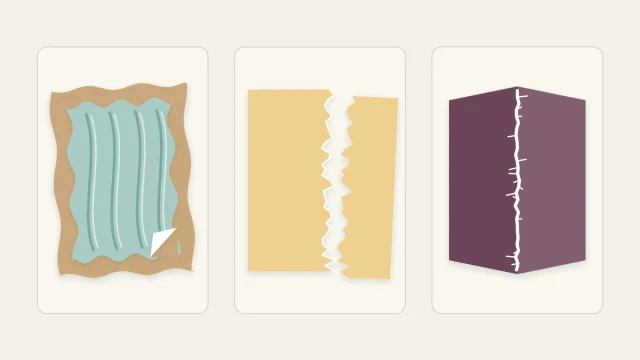
Fold a sheet of cardstock by hand and the crease rarely lands where it was meant to. It wanders, the surface along the outside of the fold breaks into a rough line, and the two halves refuse to lie flat. Learning how to score paper solves all three problems at once. A score is a pressed line that compresses the fibers along a narrow channel, creating a hinge, so the card bends exactly there and nowhere else.
Scoring takes seconds and needs almost no equipment, yet it is the step most often skipped. It is also the one that most visibly separates a neat card or box from a clumsy one.
When a score is needed
Thin paper, such as printer paper and most patterned sheets, folds cleanly without help. From light cardstock upward, around 65 lb cover (176 gsm) and heavier, score every fold. Score lighter paper too whenever a fold has to sit at an exact measurement, as in the walls of a box or the pleats of an accordion fold, because the scored line acts as a guide as well as a hinge.
Coated, metallic and white-core papers are especially prone to cracking, since the surface layer splits and shows the paper beneath. They always benefit from a score, and from a gentle one.
Tools and surface
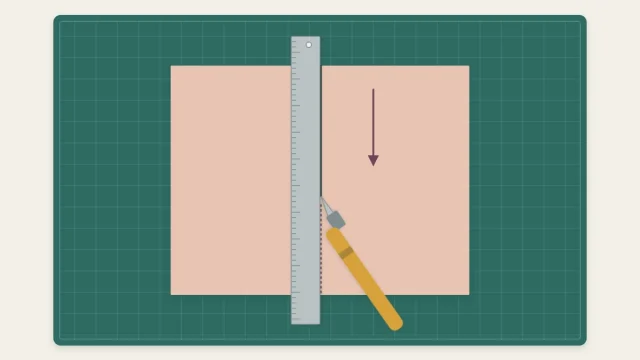
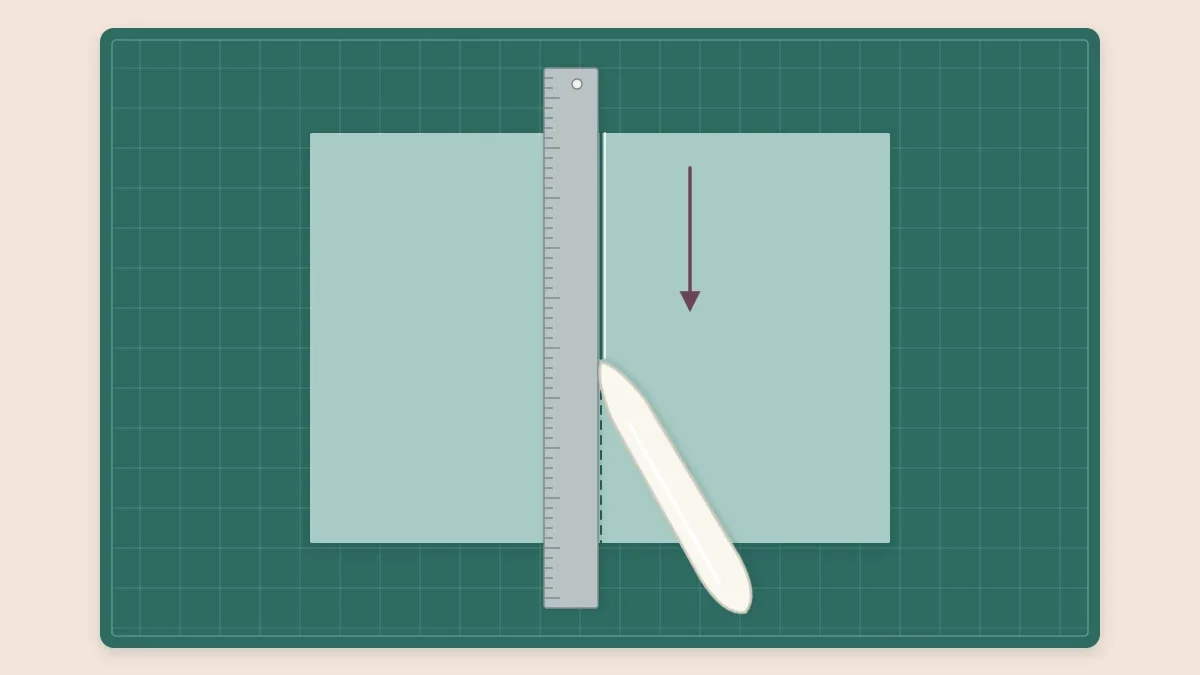
A scoring tool must be smooth and blunt: it should dent the paper, never cut it. The pointed end of a bone folder is the standard choice. A ball-tipped embossing stylus gives a finer line, and an empty ballpoint pen is a perfectly good stand-in. Avoid anything with a sharp edge.
The surface underneath matters as much as the tool. On a hard tabletop the paper has nowhere to give and the score stays shallow. A self-healing cutting mat has just enough give; so does a pad of four or five sheets of scrap paper. A metal ruler provides the straight edge.
How to score paper by hand
- Mark the fold position. Measure and make a small pencil tick at each end of the fold, close to the paper’s edges. On a card front, mark the side that will end up hidden.
- Set the ruler. Line the ruler up with both ticks, then shift it very slightly to allow for the width of the tool’s tip, so the tip itself, not the ruler’s edge, runs through the marks.
- Hold the ruler down firmly. Spread your fingers along its length. A ruler that slips mid-stroke produces a doubled or curved line that cannot be removed.
- Draw the tool along the ruler. Hold it like a pencil, tilted in the direction of travel, and pull it toward you in one steady stroke with moderate pressure. The aim is a visible, slightly shiny groove, not a cut.
- Repeat for heavy card. Two medium passes in the same groove are better than one forceful pass, which can tear the surface.
- Fold away from the groove. Scoring leaves a groove on the side you pressed and a fine raised ridge on the other side. Fold so that the ridge ends up inside the fold and the groove on the outside.
- Bring the edges together before creasing. Line up the corners, hold them in place, and only then press the fold down, working from the middle of the crease out to each end.
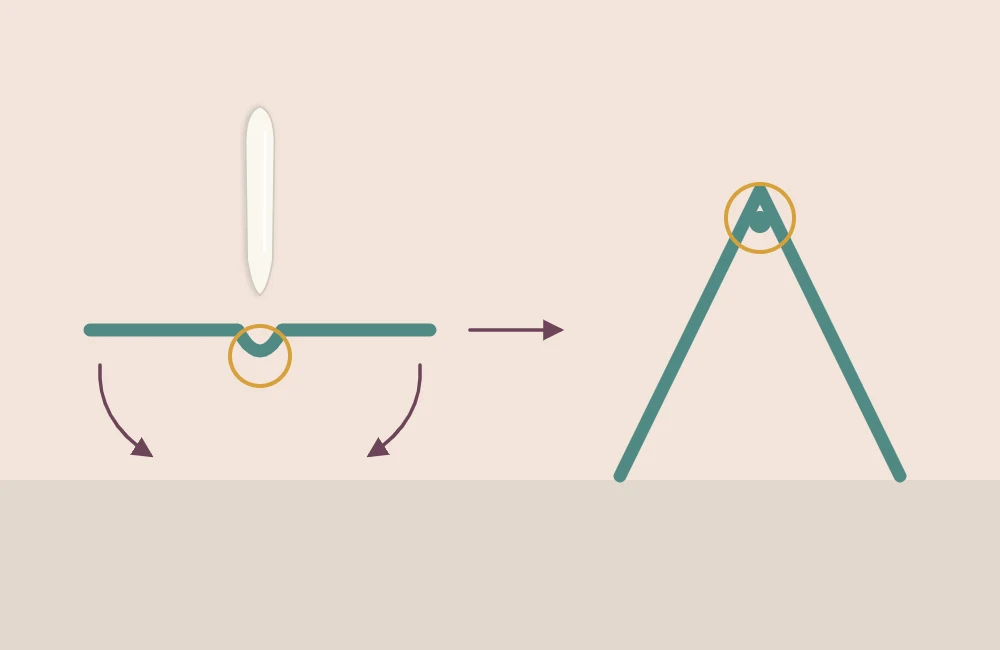
Folding in this direction means the outer surface stretches smoothly around the compressed channel instead of being forced to buckle. Folding the other way still works on lighter card, but on heavy or coated stock it is more likely to crack.
Burnishing the crease
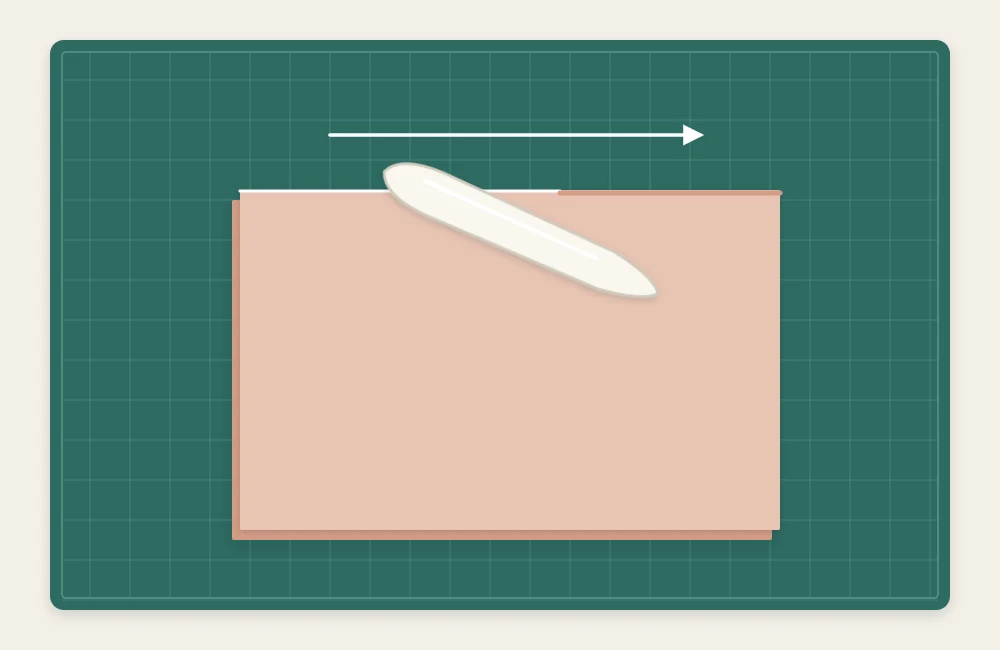
A fold pressed with the fingers is soft and tends to spring open. Burnishing sets it. Lay the folded piece flat, place the long edge of the bone folder on the crease at a low angle, and draw it along the fold with firm, even pressure. One or two strokes are enough.
Tip
Burnishing can leave a shiny streak on dark or matte card. Lay a piece of scrap paper over the fold and burnish through it to keep the surface unmarked.
Grain and fold direction
Paper folds more willingly in one direction than the other, because its fibers lie mostly one way. A fold running parallel to the grain is smoother and flatter than one running across it. Where the layout allows, turn the piece so its most important fold follows the grain; the simple bend test in the guide to paper weight, finish and grain shows how to find it. For a fold that must cross the grain, score a little more firmly and fold slowly.
Scoring for particular jobs
Card bases
Score across the exact center of the sheet and fold once. Measure the halfway point at both edges instead of trusting the eye; a difference of a sixteenth of an inch is enough to make the front and back visibly uneven. Sizes and layouts are covered in the guide to making a first handmade card.
Boxes and other 3D forms
Score all the lines before cutting any tabs or corners. A full, uncut sheet lies flat and gives the ruler solid support, whereas a partly cut one shifts. Fold each line once in its correct direction and burnish lightly before assembly, as in this lidded gift box.
Accordion folds
Pleats alternate direction, one fold up and the next down. Scoring every line from the same side is acceptable on light paper, since the score still guides the fold. On heavier card, turn the sheet over for every other line so that each ridge ends up inside its own fold. Even spacing matters more than anything else here, as the pleats of accordion-fold paper rosettes show.
Fixing common problems
| Problem | Likely cause | What to do |
|---|---|---|
| Fold cracks along the outside | No score, score too shallow, or folded against the grain | Score more firmly on a softer surface; fold with the ridge inside; change orientation if possible |
| Score line cut through the paper | Tool too sharp or pressure too high | Use a blunter tip and two lighter passes |
| Crease is not straight | Ruler moved during the stroke | Press down along the ruler’s whole length; use a non-slip ruler |
| Fold lands beside the marks | Tool width not allowed for | Offset the ruler so the tip passes through the ticks |
| Edges do not line up | Creased before aligning the corners | Match the corners first, then press from the middle outward |
A useful ten-minute exercise is to cut a few strips from an offcut of each cardstock you own and fold each strip twice: once unscored and once scored. Keep the results clipped together. They show at a glance how each paper behaves, and how much pressure it needs, before any of it goes into a project.
Frequently asked questions
What can I use to score paper without a bone folder?
An empty ballpoint pen or a ball-tipped embossing stylus works well. The tool must be smooth and blunt so that it dents the paper without cutting it.
Which way do you fold a scored line?
Scoring leaves a groove on the side you pressed and a raised ridge on the other. Fold so the ridge sits inside the fold and the groove is on the outside, which reduces cracking on heavy or coated card.
Why does my cardstock crack when I fold it?
Usually because the fold was not scored, the score was too shallow, or the fold runs across the grain. Coated and white-core papers crack most readily. Score more firmly on a slightly soft surface and fold slowly.