Paper Craft Tools: What You Need and What Can Wait
Four tools are enough to begin. Here is what to buy first, what to add after a few projects, and which household items can stand in until then.
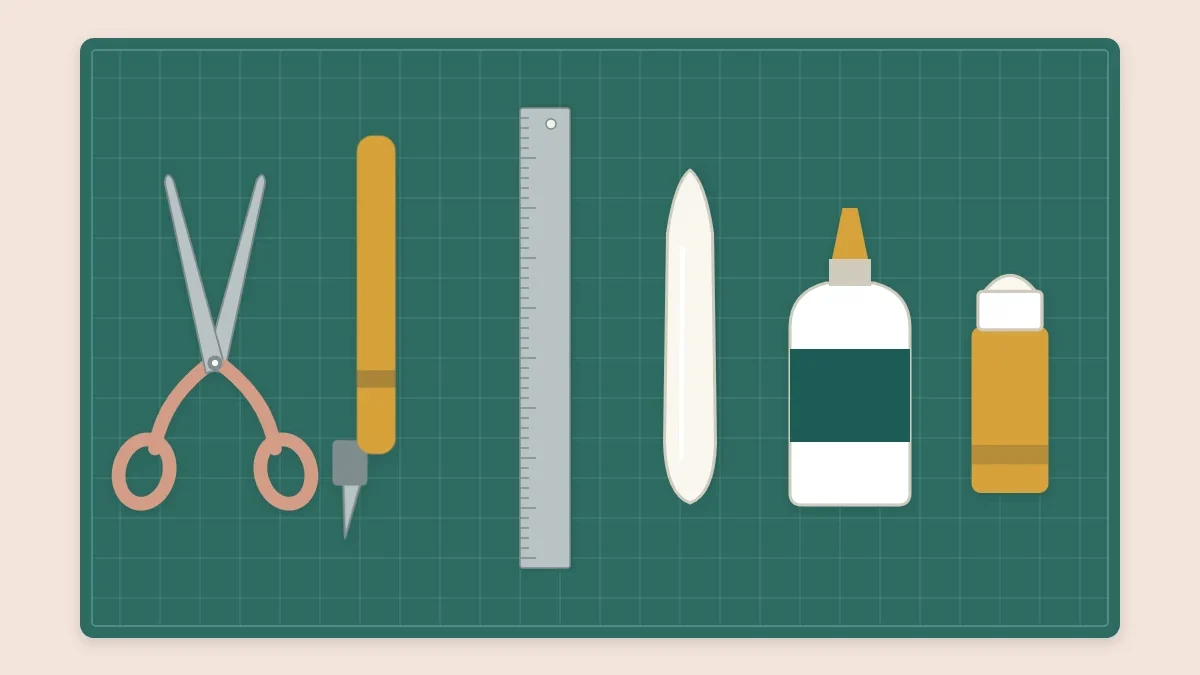
The tool aisle of a craft store suggests that paper work requires dozens of specialized gadgets. It does not. The full list of paper craft tools that a beginner needs fits in a pencil case, and most of the rest can be added one at a time, when a particular project calls for it. Buying in stages costs less, and it also means each new tool arrives when you already understand what problem it solves.
Stage one: the four essentials
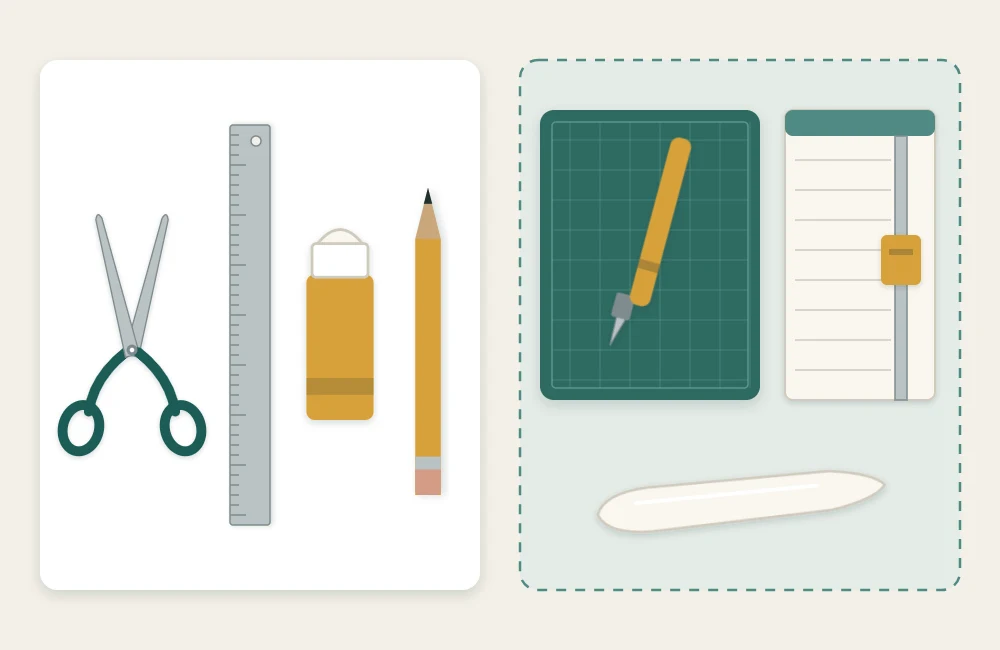
These four are enough to cut, measure, mark and assemble a wide range of simple projects.
- Scissors. A pair with blades around 5 to 6 in (13–15 cm) long, sharp to the tip, that closes smoothly without wobble at the pivot. Keep them for paper only; cutting tape, wire or fabric dulls and gums up the edges.
- Ruler. A 12 in (30 cm) metal ruler is worth choosing from the start, even before owning a knife, because it will later serve as a cutting guide. A cork or non-slip backing helps it stay put. Clear markings in both inches and centimeters are useful.
- Glue stick. A permanent, acid-free stick handles most flat paper-to-paper joins with very little warping.
- Pencil and eraser. A sharp HB pencil for light marks and a soft white eraser that lifts them without smudging or roughening the surface.
Stage two: later purchases that earn their place
After a few projects, certain limits become obvious. Scissors cannot cut a window from the middle of a sheet, folds in cardstock look soft, and long straight cuts drift. These four tools address exactly those limits.
Craft knife
A pen-style knife with replaceable pointed blades makes straight cuts against a ruler and reaches inside corners and openings that scissors cannot. The handle matters less than the blade supply: buy spare blades at the same time, because a fresh blade is what produces a clean edge. Handling is covered in detail in the guide to cutting cleanly with scissors and a knife.
Self-healing cutting mat
A knife needs a mat. It protects the table, grips the paper slightly and preserves the blade tip. An 18 × 12 in mat (roughly A3) suits US Letter and A4 sheets with room to spare; a 12 × 9 in mat is workable in a small space. Printed grid lines help with squaring up paper but are no substitute for measuring.
Bone folder
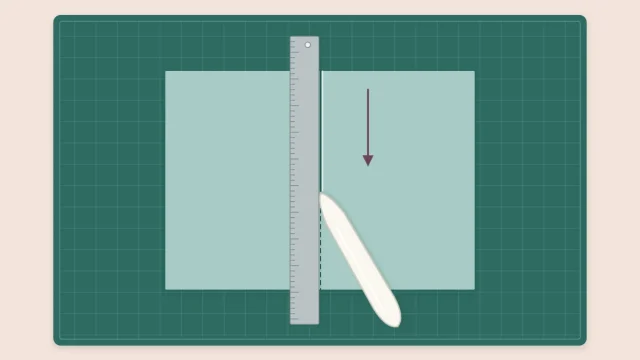
This smooth, blunt-edged tool, traditionally bone and now often plastic or another synthetic, does two jobs. Its point presses score lines into card, and its long edge flattens folds and smooths glued layers. It is inexpensive and makes an immediate difference to anything folded, as shown in the guide on how to score and fold for sharp creases.
Paper trimmer
A trimmer, whether a sliding-blade model or a guillotine, cuts straight, square edges quickly and repeatedly. It becomes worthwhile once you are cutting many identical pieces, such as card bases, strips for weaving or panels for layered cards. For occasional cuts, a knife and ruler do the same job with more control over where the cut starts and stops.
Watch out
Craft knife blades are extremely sharp and break if bent sideways. Cap or retract the knife whenever it is put down, keep the hand holding the ruler behind the cutting edge, and dispose of used blades wrapped in tape or in a closed container, never loose in a wastebasket.
What can wait longer
The following are useful, but only for particular kinds of work. None is needed to get started.
- Liquid PVA glue and a fine-tip applicator for small parts and edge-to-edge joins. The differences between adhesives are set out in the guide on which glue to use when.
- Hole punch and shape punches for tags, garland circles and repeated shapes. A single-hole punch is the most broadly useful.
- Scoring board, a grooved board that speeds up accurate scoring for people making many cards and boxes.
- Circle cutter or compass for large, accurate circles.
- Fine-point tweezers for placing small pieces without leaving fingerprints in the glue.
- Slotted quilling tool, needed only for rolled-strip work. It is introduced in the beginner’s guide to quilling.
- Electronic cutting machine. A significant purchase that suits people who want to cut complex digital designs in quantity. It replaces neither hand skills nor the understanding of paper that hand cutting builds, so there is no reason to rush toward one.
Substitutes already in the house
Before buying a stage-two tool, it is reasonable to try a stand-in. These work well enough to finish a project and to find out whether the proper tool is worth owning.
| Instead of | Try | Limitation |
|---|---|---|
| Bone folder | An empty ballpoint pen for scoring; the back of a spoon for flattening folds | A pen that still has ink will mark the paper; a metal spoon can leave a shine on dark card |
| Cutting mat | A piece of thick, dense cardboard | Grooves build up and catch the blade, so replace it often |
| Paper trimmer | Craft knife and metal ruler | Slower for repeated identical cuts |
| Circle punch | Trace around a glass or jar lid and cut with scissors | Edges depend on a steady hand |
| Tweezers | The tip of the craft knife, used to lift and place small pieces | Needs a light touch to avoid marking the paper |
Keeping tools in working order
Paper is mildly abrasive, and edges that seem sharp lose their bite sooner than expected. Change a knife blade as soon as it starts to drag, tear or need extra pressure; continuing with a dull blade is the most common cause of ragged cuts and of slips. Wipe glue residue from scissor blades with a slightly damp cloth and dry them straight away.
Store a cutting mat flat and away from heat. Mats left leaning against a radiator or in a hot car can warp permanently. Keep the bone folder clean, since any dried glue on its edge will transfer to the next fold. Finally, give the small items a fixed home, whether a tray, a lidded box or a zip pouch. A project started without ten minutes of hunting for the pencil is a project more likely to be started at all.
Frequently asked questions
What is a bone folder used for?
It presses score lines into card so folds land accurately, and its long edge flattens creases and smooths glued layers. Modern versions are often plastic or another synthetic rather than bone.
Do I need a paper trimmer if I have a craft knife and ruler?
Not at first. A knife and metal ruler make the same straight cuts. A trimmer becomes worthwhile when you regularly cut many identical pieces, such as card bases or strips.
How often should a craft knife blade be changed?
Whenever it starts to drag, tear the paper or need more pressure. There is no fixed interval, because wear depends on the paper and how much cutting is done, so keep spare blades on hand.